A Practical Journey Into Hydrogen Aviation Research: My Secondment at the University of Birmingham
Reflections on a HI-ACT Secondment Fund placement at the Birmingham Energy Institute (BEI)—building hydrogen aviation models, expanding collaboration networks, and sharpening the research roadmap for airport energy systems.
Why the secondment mattered
As the only energy engineering researcher within my department (Data Science, AI and Modelling Centre) at the University of Hull, I have been exploring hydrogen aviation, multi-energy optimisation, and future airport energy systems—often without an immediate peer group. The secondment at BEI arrived at a crucial time, offering both technical insight and a research ecosystem that clarified the direction of my work.
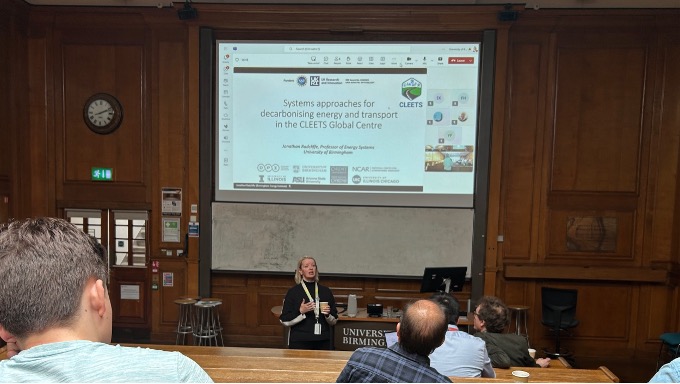
Travelling between Hull and Birmingham
The three-hour train journey became part of the rhythm: balancing a laptop on a moving table to read, code, reply to emails, and occasionally doze when the carriage warmed up. Stepping onto the Birmingham campus, the atmosphere was consistently worthwhile—structured, research-driven, and collaborative, with teams sketching constraints and refining models.
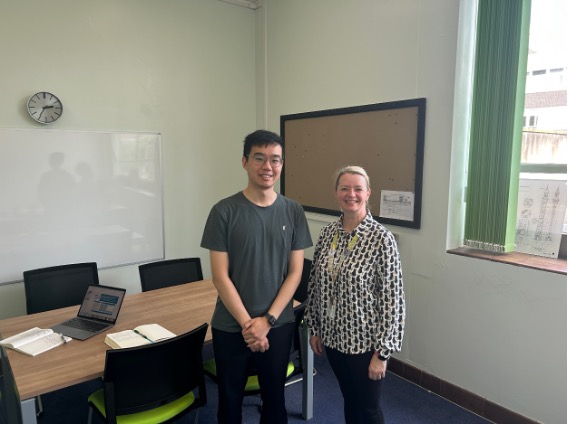
Structured collaboration at BEI
Weekly sessions with Professor Sara Walker helped position my work in a broader systems context—how hydrogen integrates with airport infrastructure, where bottlenecks arise, and which constraints matter most for national strategies. Sara also opened doors across BEI and HI-ACT:
- Dr Hadi Heidary: high-resolution hydrogen demand modelling for airports.
- Dr Saeed Harati: storage configurations and scalability.
- Dr Tongtong Zhang and Dr Jian Song: techno-economic frameworks for hydrogen supply chains; they later visited Hull for in-person discussions.
These exchanges turned fragmented ideas into a clearer, more coherent direction.
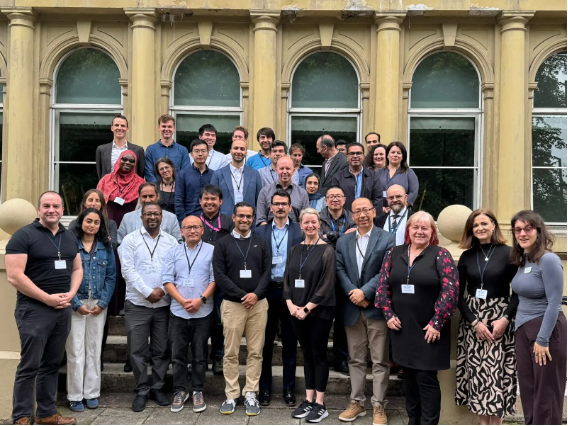
Expanding the network: HI-ACT All Hands in Glasgow
At the HI-ACT All Hands Meeting, conversations with Professor David Flynn and Work Package 3 colleagues focused on coupling hydrogen systems with transport electrification digital twins. We discussed how future hydrogen production, storage, and refuelling demands interact with power-system planning, and how AI methods—forecasting, reinforcement learning, hierarchical optimisation—fit into hydrogen aviation and multi-energy modelling.
Research outcomes
- 2040 hydrogen demand scenario model for Birmingham Airport (BHX), covering flight schedules, energy requirements, and infrastructure assumptions.
- Preliminary hydrogen supply chain optimisation framework balancing cost, emissions, operational feasibility, and spatial constraints.
- Presented at the APEN-Disco workshop in Cardiff and invited to submit a journal paper to Applied Energy.
- Collaborative review article synthesising technology readiness, economics, and system-level considerations of hydrogen aviation.
- A sustained collaboration mechanism between Hull, Birmingham, and HI-ACT: regular meetings, shared modelling tools, and future grant conversations.
Impact
- Clearer research roadmap for hydrogen-powered aviation, airport energy systems, and AI-enabled optimisation.
- Stable collaboration network that will support future projects, publications, and student development.
- Better alignment with national and industrial needs, grounding future engagement with airports, energy companies, and policymakers.
Looking ahead
- Hydrogen aviation system modelling, focusing on future airport infrastructure requirements.
- Multi-energy system optimisation, integrating hydrogen systems with electricity networks.
- AI-driven forecasting and control, linking data science methods with energy engineering problems that need smarter solutions.
The secondment was more than an academic exercise—it connected Hull, Birmingham, and the wider HI-ACT community, clarified the next stages of my research, and strengthened the collaborations needed to pursue them effectively.